Kremlin Tower Clock
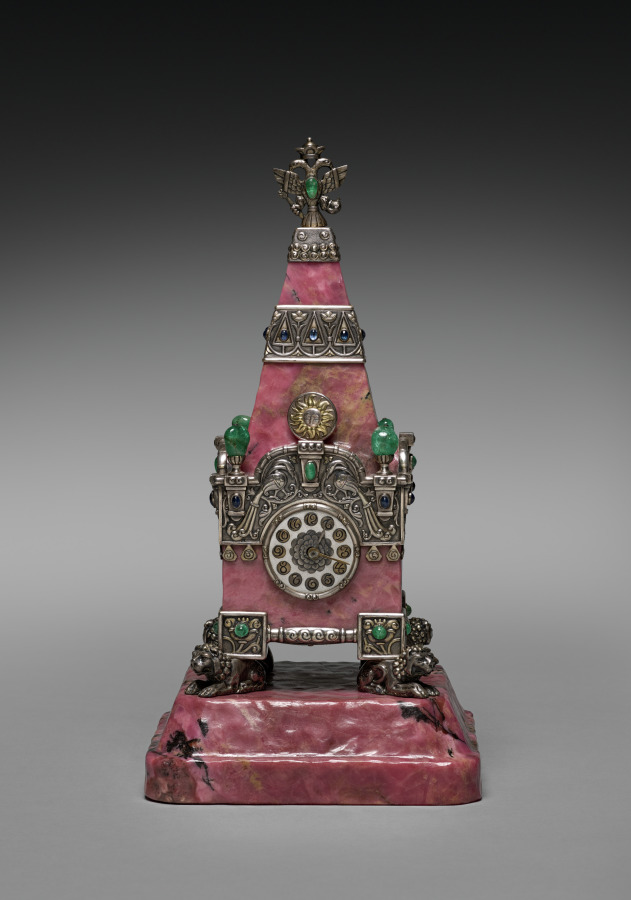
| 작가 | House of Fabergé (Russian, 1842–1918) |
|---|---|
| 제작 시기 | c. 1913 |
| 분류 | Timepiece |
| 재료·기법 | rhodonite, silver, enamel, emeralds, sapphires |
| 문화권 | Russia, St. Petersburg |
| 소장 부서 | Decorative Art and Design |
| 이용 조건 | 퍼블릭 도메인 (CC0) — 수업·인쇄에 자유롭게 사용 가능 |
작품 설명
The use of Russian hardstones in creating precious objects became a hallmark of design from the House of Fabergé. Easily carved, these minerals were sourced largely from the western region surrounding the Ural Mountains. Fabergé's workmasters used colorful stones such as agate, nephrite (jade), lapis lazuli, rock crystal, and rhodonite, seen here in this elaborate table or mantel clock, to create all manner of luxurious accessories. Bright pink rhodonite was among the rarest, and consequently most expensive, specimens used by the House of Fabergé. <br><br>This clock resembles the Taynitskaya Tower, the middle tower on the south side of the Kremlin. The House of Fabergé created this work to commemorate the 300th anniversary of the Romanov dynasty, representing Fabergé's ability to balance the functionality of objects with intricate decorative design.
수업에 이렇게 활용하세요
이 작품은 퍼블릭 도메인이라 수업 자료로 자유롭게 내려받아 인쇄하거나 화면에 띄워 쓸 수 있습니다. House of Fabergé의 표현 방식을 관찰하고 따라 그려 보거나, rhodonite, silver, enamel, emeralds, sapphires 기법에 대해 이야기 나누는 감상 수업에 활용할 수 있습니다.
함께 보면 좋은 작품
- Flower Study of a Lily of the Valley — House of Fabergé
- Parrot on a Perch — House of Fabergé
- Turtle Bell Push — House of Fabergé
- Miniature Chair — House of Fabergé
- Flower Study of a Wild Rose — House of Fabergé
- Flower Study of a Lowbush Cranberry or Lingonberry — House of Fabergé
이미지 출처: 클리블랜드 미술관(The Cleveland Museum of Art) 오픈액세스. 원본 소장 정보 · LUNA WHALE ART에서 더 많은 명화 검색하기