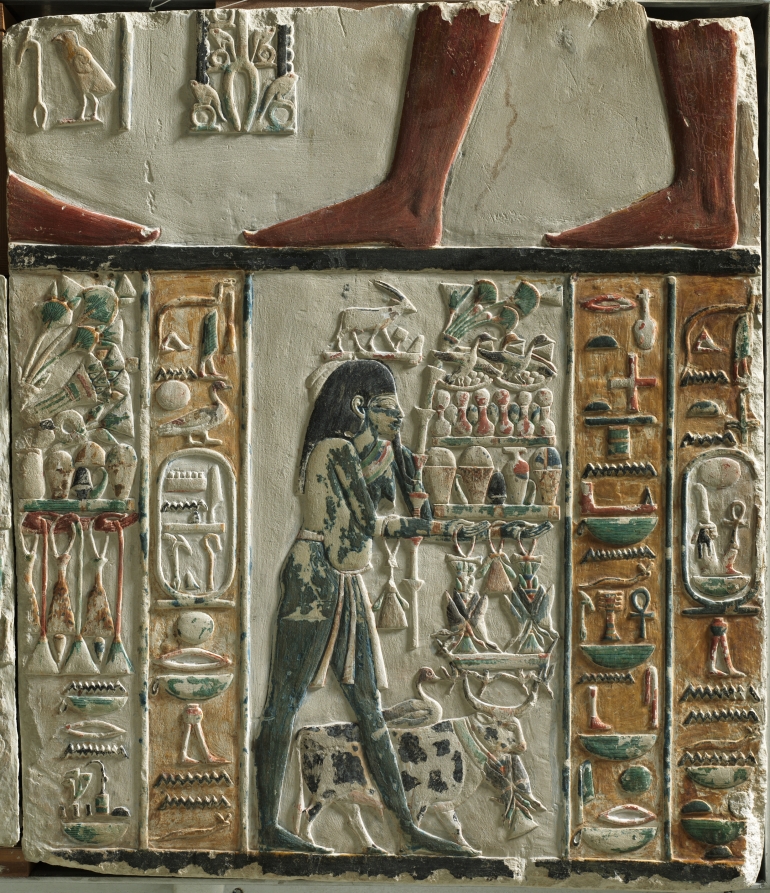
Nome Gods Bearing Offerings
| 제작 시기 | c. 1391–1353 BCE |
|---|---|
| 분류 | Sculpture |
| 재료·기법 | painted limestone |
| 문화권 | Egypt, New Kingdom (1540–1069 BCE), Dynasty 18, reign of Amenhotep III (1390–1352 BCE) |
| 소장 부서 | Egyptian and Ancient Near Eastern Art |
| 이용 조건 | 퍼블릭 도메인 (CC0) — 수업·인쇄에 자유롭게 사용 가능 |
작품 설명
These blocks from a temple wall have preserved their original painted decoration to a remarkable degree. The four portly figures in the lower register bear emblems on their heads identifying them as nomes, or provinces, of ancient Egypt. Carrying trays heaped with offerings and leading sacrificial animals, they personify the bounty of the land. First (on the right) is the Oryx Nome, followed by the Dog Nome, the Falcon Nome, and the Double Scepter Nome. The face of each nome figure is a miniature portrait of Amenhotep III, and each recites a speech in the king's name. The first figure says, "King Nebmaatra [Amenhotep III] has come, bringing to you every good thing that is in this land, that you may give him all life, stability, dominion, and all health from you." The second, third, and fourth figures bring "all greens," "the produce of the Two Lands [Upper and Lower Egypt]," and "all offerings and provisions." The god to whom the nomes bring offerings stood in the fragmentary upper register, facing a standing figure of the king, Amenhotep III. The pair of legs on the right belonged to the god; the single foot on the left belonged to the king. The god held a scepter, forked at the bottom, embellished with coils of rope (for eternity), tadpoles (for hundreds of thousands), and notched palm ribs (for years), the whole signifying "an eternity of hundreds of thousands of years." These blocks may be from Amenhotep III's temple at Kom el-Ahmar, ancient Hebenu, in Middle Egypt, dedicated to the god Horus. Hebenu was the capital of the Oryx Nome, which leads the procession of nome gods. Amenhotep III's temple was later dismantled, and its blocks were reused in the foundations of another structure, which would account for the excellent preservation of the paint.
수업에 이렇게 활용하세요
이 작품은 퍼블릭 도메인이라 수업 자료로 자유롭게 내려받아 인쇄하거나 화면에 띄워 쓸 수 있습니다. 작품의 표현 방식을 관찰하고 따라 그려 보거나, painted limestone 기법에 대해 이야기 나누는 감상 수업에 활용할 수 있습니다.
함께 보면 좋은 작품
- Portrait of Dora Wheeler — William Merritt Chase
- Stag at Sharkey's — George Bellows
- The Biglin Brothers Turning the Stake — Thomas Eakins
- The Race Track (Death on a Pale Horse) — Albert Pinkham Ryder
- Twilight in the Wilderness — Frederic Edwin Church
- Church Street El — Charles Sheeler
이미지 출처: 클리블랜드 미술관(The Cleveland Museum of Art) 오픈액세스. 원본 소장 정보 · LUNA WHALE ART에서 더 많은 명화 검색하기