Priest-King or Deity
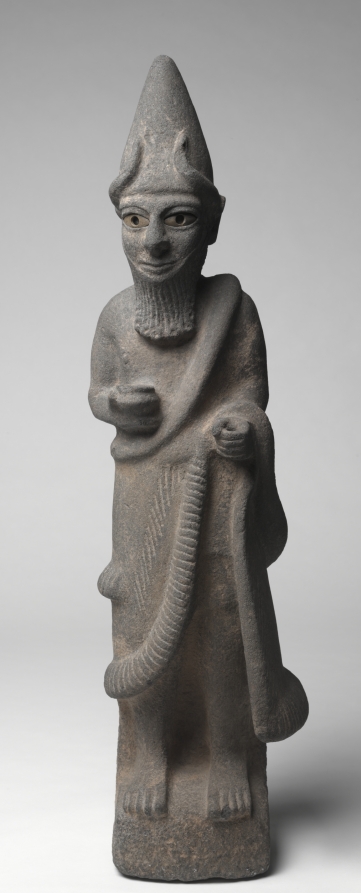
| 제작 시기 | c. 1600 BCE |
|---|---|
| 분류 | Sculpture |
| 재료·기법 | basalt with bone eyes (left, ancient; right, restored) |
| 문화권 | Hittite, North Syria |
| 소장 부서 | Egyptian and Ancient Near Eastern Art |
| 이용 조건 | 퍼블릭 도메인 (CC0) — 수업·인쇄에 자유롭게 사용 가능 |
작품 설명
The Hittites migrated into Anatolia in the 3rd millennium BCE and spoke an Indo-European language, a group that includes Greek, Latin, Persian, Sanskrit, English, and most modern European languages. They were the first ancient people to use iron for weapons. From about 1600–1200 BCE their empire was at its peak, extending from central Anatolia to Syria, and south along the eastern Mediterranean. Their vast empire and interest in commerce enabled the Hittites to spread Mesopotamian ideas and culture throughout the ancient Mediterranean world. This large basalt sculpture is exceptionally rare in depicting a Hittite god or priest-king wearing a horned conical crown, false beard, and long robe. He holds a bowl in his right hand and once held something in his left, perhaps a staff or sword.
수업에 이렇게 활용하세요
이 작품은 퍼블릭 도메인이라 수업 자료로 자유롭게 내려받아 인쇄하거나 화면에 띄워 쓸 수 있습니다. 작품의 표현 방식을 관찰하고 따라 그려 보거나, basalt with bone eyes (left, ancient; right, restored) 기법에 대해 이야기 나누는 감상 수업에 활용할 수 있습니다.
함께 보면 좋은 작품
- Portrait of Dora Wheeler — William Merritt Chase
- Stag at Sharkey's — George Bellows
- The Biglin Brothers Turning the Stake — Thomas Eakins
- The Race Track (Death on a Pale Horse) — Albert Pinkham Ryder
- Twilight in the Wilderness — Frederic Edwin Church
- Church Street El — Charles Sheeler
이미지 출처: 클리블랜드 미술관(The Cleveland Museum of Art) 오픈액세스. 원본 소장 정보 · LUNA WHALE ART에서 더 많은 명화 검색하기